
05 Aug How to Pick a Crate for High-Anxiety Dogs in CA
If your dog panics during thunder, scratches metal bars until their paws bleed, or has broken out of every “escape-proof” crate you’ve tried, you know the struggle is real. Choosing the right crate isn’t just about containment—it’s about creating a safe, den-like environment that actually lowers your dog’s stress hormone. In California, where earthquake alarms, fireworks, and dense urban noise are common triggers, you need more than a basic wire cage. You need a fortress that feels like a sanctuary. This guide will walk you through every decision point, from material strength to ventilation and CA-specific climate concerns.
What Makes a Crate “Heavy Duty” for Anxious Dogs?
A heavy-duty crate differs from a standard kennel in material gauge, locking mechanism, and structural rigidity. For high-anxiety dogs, the crate must withstand both physical force (pushing, chewing, pawing) and psychological stress (the dog must not be able to see a “weak point” to obsess over). True heavy-duty crates use 10-12 gauge steel, reinforced corner welds, and double-latch doors that cannot be manipulated by a determined paw or nose.
Material Thickness and Frame Construction
Look for welded wire or solid steel panels rather than folded metal. A 12-gauge wire is 2.05 mm thick—this is the minimum for anxious dogs. Cheaper crates often use 16-gauge (1.5mm), which bends under repeated pressure. The frame should have continuous welds at every junction, not just spot welds. Avoid crates with plastic connectors or plastic base trays that attach with clips; these are the first failure points.
Locking Mechanisms That Defeat Clever Paws
Standard slide-bolt locks are useless for an anxious dog that has learned to slide them open. You need a lock that requires two separate actions to open—ideally a spring-loaded pin latch combined with a manual thumb slide. Some premium models feature a “lock-out” slider that physically prevents the latch from moving even if the dog manages to hit it. Test the latch yourself: if you can open it with one hand while wearing a thick glove, a determined dog will figure it out too.
Panel Strength vs. Wire Strength
For extreme chewers, solid steel panel crates (often called “aviary” or “airline” style) are better than wire mesh. Solid panels give the dog a more den-like feel—the darkness reduces visual stimulation, which is a natural anxiety reducer. However, these crates are heavier and less portable. If you need a wire crate, ensure the wire spacing is less than 2 inches so the dog cannot grip the bars with their teeth.
Why Do Anxious Dogs Fail in Standard Crates?
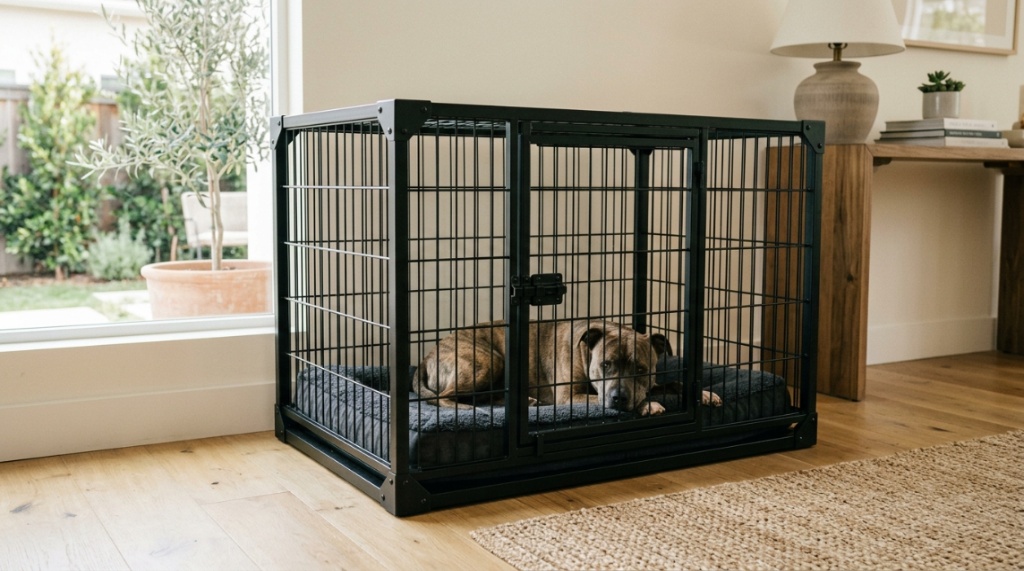
Anxious dogs do not fail because they are “bad”—they fail because standard crates violate key psychological needs. A flimsy crate rattles, creating noise that amplifies fear. A wire crate with 360-degree visibility forces the dog to track every moving object, which prevents the brain from entering a rest state. Most importantly, a crate that shakes or flexes under pressure reinforces the dog’s belief that the threat is real and the panic is justified.
The “Cave” Instinct and Visual Barriers
Dogs evolved as den animals—safe spaces are enclosed, dark, and quiet. If your anxious dog can see the mailman, the neighbor’s cat, or a flickering shadow, their prey drive and fear response stay “on.” Heavy-duty crates often come with a partial cover, or you can add a fitted cover. The goal is to block 80% of visual input while maintaining airflow. In California’s warmer climate, you need a cover that breathes, not a thick plastic tarp.
The Impact of Crate “Flex” on Panic Levels
When a dog pushes against a crate wall and it bows inward by even 1–2 inches, the dog interprets this as “I can escape if I try harder.” This leads to escalated scratching and biting. High-quality heavy-duty crates have cross-bracing or a solid base plate that prevents any visible deflection. You should be able to lean your full weight against the side of the crate without it moving.
Which Crates Are Best for CA Noise Phobias (Fireworks & Thunder)?
Noise phobias require a crate that offers acoustic dampening and a sense of physical enclosure, not just strength. In California, wildfire evacuation alerts and unexpected fireworks can trigger hours-long panic episodes. The best crates for noise anxiety combine a solid top and partial side panels with a durable base that doesn’t amplify sound vibrations.
Sound Dampening Features to Look For
Metal crates naturally reverberate sound. To combat this, look for crates that allow you to attach acoustic foam panels to the inside walls (some premium models include clips for this). Alternatively, consider a heavy-duty aluminum crate with rubber feet—the feet isolate the crate from floor vibrations. When thunder hits, the crate itself won’t hum and vibrate like a tuning fork.
Ventilation vs. Soundproofing Balance
You don’t want a completely sealed box—that can cause hyperthermia. In CA, especially in areas like Sacramento or Fresno, where summer temps exceed 95°F, you need airflow. The ideal crate has windows on three sides but a solid roof and a solid lower half. This blocks ground-level noise (like sliding doors slamming) while allowing heat to escape through the top.
Before deciding on confinement, it’s also vital to evaluate your daily walking gear by reading our guide on dog harness vs. collar health differences to ensure your dog’s overall safety and comfort during training.
How to Measure Your Dog for a Heavy-Duty Crate
The correct size is crucial. Standard advice—”dog should stand, turn around, and lie down”—is insufficient for anxious dogs. They need extra length to stretch out during a panic episode (muscle tension requires space) and extra height to sit upright without hitting their head. A cramped crate increases claustrophobia.
Length and Height: The 1.2x Rule
Measure from the tip of your dog’s nose to the base of the tail (not the end of the tail). Multiply that by 1.2 to get the minimum crate length. For height, measure from the floor to the top of the standing dog’s head (ears flat), then add 4–6 inches. Anxious dogs often pace—they need enough room to take two steps forward and turn around without ducking.
Weight Capacity and Floor Space
Check the weight rating, but also look at the floor dimensions. A crate rated for 90 lbs might have a footprint of 42″ L x 28″ W—this is okay for a lean greyhound but too narrow for a bulldog with a wide chest. For anxious dogs, extra floor width is more important than height, as it allows them to side-step and reposition without flipping over in a panic.
Can a Solid Steel Crate Help with Separation Anxiety?
Yes, but only if used correctly. Solid steel crates help separation anxiety by blocking visual triggers (like you leaving through the same door) and by creating a “safe room” the dog associates with calmness. The key is to feed meals and give high-value treats only inside the crate, so the dog builds a positive conditioned response over several weeks.
Building Positive Associations (Not a Panic Chamber)
Never use the crate as a timeout space. If you only put the dog in the crate when you leave, they will hate it. Start by leaving the crate door open during the day, dropping treats inside randomly. Then, practice closing the door for 30 seconds while you stand nearby, gradually increasing the time. This groundwork is what distinguishes a helpful tool from a stress amplifier.
When a Crate Isn’t Enough: Safety Net Options
For severe separation anxiety (destruction, self-harm, elimination), a crate alone might not suffice. Consider combining the heavy-duty crate with a calming supplement (like L-theanine), a pheromone diffuser near the crate, and a white noise machine. Do not leave a dog with severe anxiety in a crate for more than 4 hours at a stretch without a break.
Must-Have Features for California’s Climate and Earthquake Risk
Californians face two unique challenges: extreme heat (inland) and earthquakes (statewide). Your crate must handle both. A welded wire crate with a removable pan is easier to clean after an earthquake (when dogs often get diarrhea from stress), but you also need a crate that won’t crush if a shelf falls on it. Look for a reinforced top panel.
Breathability and Heat Dissipation
In hotter regions like Palm Springs or Bakersfield, solid steel panels on all four sides can cause heat stress. Choose a crate that has a solid roof and lower half but wire mesh on the top half of the side walls. This allows rising heat to escape while keeping the dog visually shielded at nose level. Ensure the crate is not placed in direct sunlight near a window.
Stability and Anti-Tipping Design
A panicking dog can tip a lightweight crate. Heavy-duty crates should have a low center of gravity—the base pan should be heavy-duty plastic (¼ inch thick) or stamped steel. Also, check the rubber feet: they should be wide and non-slip. In an earthquake, the crate will slide if the feet are inadequate. You can add adhesive rubber pads to increase friction.
How to Test the Safety of the Crate Before Buying
You can’t bring your dog to the store and ask them to panic, but you can perform a physical stress test on the crate. Look for sharp edges, pinch points in the folding mechanism, and the overall fit of the base tray. The base tray should be flush with the walls—no gaps where a toe or tongue can get caught.
Quick Stress Test Checklist
- Shake test: Grab the top of the crate and shake vigorously. If it rattles or flexes, it’s too weak.
- Latch test: Attempt to open the door by pressing on the center, top, and bottom. It should not flex.
- Tooth test: Check for any plastic parts on the inside that are within reach of the dog’s mouth.
- Corner test: Press on the corners where the walls meet the floor. No clicking or bending allowed.
If you are comparing models, a reliable resource for curated, budget-conscious options is this guide to the heavy-duty dog crate California market. It breaks down the top picks under $300 that still pass these safety tests.
Why a Proper Base Tray Matters
Anxious dogs often dig and pace, which rubs the skin off their paw pads. A smooth, seamless base tray is essential. In cheaper crates, the tray has a lip that the wire cage sits behind—leaving a 1/4-inch gap that catches toenails. Premium crates have a tray that sits flush with the interior walls, offering zero snag points.
Best Materials for Chewers: Aluminum vs. Welded Wire vs. Polymer
Each material has a specific trade-off. Welded wire is the most common heavy-duty material—it’s tough, but a determined chewer can eventually bend a wire if the gauge is too low. Aluminum is lighter and doesn’t rust, making it ideal for coastal areas like San Diego, but it’s more expensive and can dent. Reinforced polymer (like used in flight kennels) is chew-resistant but can be heavy and retain heat.
Welded Wire: The Balanced Choice
Choose 10-gauge or 11-gauge welded wire with 2″ x 2″ spacing. This is thick enough to be chew-resistant but thin enough to see through. Make sure the wire is coated with a non-toxic, scratch-resistant powder coat (zinc coating is a red flag if the dog chews—it can cause zinc toxicity).
Aluminum: For the Beach Dog
If you live near the ocean, salt air corrodes steel. An aluminum crate (like those used by police K9 units) is corrosion-proof and weighs 30% less than steel, which is great if you need to move it. However, aluminum is softer than steel—it can get chewed on the edges. Only choose this if your dog is a “shover” and not a “chewer.”
Heavy-Duty Polymer: For Separation Anxiety
Polymer crates (like the Roto-Molded kind) are completely opaque. This creates a maximum “den” effect and is excellent for calming anxious dogs. But they offer zero ventilation on three sides. Use them only in air-conditioned homes or during winter months. They are also incredibly heavy and awkward to move.
Setting Up the Crate to Maximize Calming Effects
The location and setup of the crate have as much impact as the crate itself. Place the crate in a low-traffic room, but not one that is completely isolated. A corner with two walls supporting the crate is ideal—it reduces the crate’s perceived vulnerability. Maintain a consistent “crate routine” (treats, music, covered top) so the dog recognizes the cue to relax.
The 3-Zone Setup: Sleeping, Eating, Retreat
Inside the crate, create zones: a soft bed at the back (sleeping), a water bowl clipped to the side (hydration), and a chew toy near the front (engagement). Use a waterproof, chew-proof mat (like Kevlar-lined ones) rather than a fluffy bed that can be shredded and ingested.
Using the Crate During the Day (Preventing Overuse)
Do not leave your anxious dog in the crate all day. Even with a heavy-duty crate, a dog needs 6-8 hours of free-roaming time daily. Use the crate for nighttime sleep and for 1-2 hour intervals when you are away. If you work 10-hour shifts, consider a dog walker to break up the time.
Cost vs. Value: Is Heavier Worth It?
A cheap heavy-duty crate might cost $80, but if it fails after one panic episode and your dog escapes into a busy CA street, the cost of emergency vet bills or a lost dog far exceeds the $300 difference. Invest in the strongest crate you can afford. You are not just buying metal—you are buying the peace of mind that protects your dog from harming themselves.
Where to Cut Costs (Without Sacrificing Safety)
Avoid crates with added “tech” features like built-in cameras or app-controlled locks—they are unnecessary if the mechanics are solid. Spend your money on thicker wire and better welds. Buy the largest size you have room for; too small is a safety hazard. Also, check if you can buy replacement base trays separately, as they wear out fastest.
Long-Term Durability in High-Abrasion Environments
In CA, the sun can degrade plastic clips and rubber feet over time. Choose a crate with metal feet or replace them with rubber floor glides. Periodically check the powder coating for scratches—if you see bare metal, repaint it with a non-toxic enamel spray to prevent rust, especially in coastal humidity.
Frequently Asked Questions
Are heavy-duty dog crates escape-proof?
No crate is truly 100% escape-proof, but a properly assembled heavy-duty crate with 10-gauge steel and double locks is resistant to 99% of determined dogs. For extreme diggers, add a wire floor or place the crate on a solid surface to prevent escape from underneath.
Can I use a heavy-duty crate for housetraining?
Yes, but avoid keeping a puppy in a crate for too long. A heavy-duty crate for a puppy should be sized to just fit them (using a divider) to prevent eliminating in one corner and sleeping in another.
How do I clean a heavy-duty crate after an anxiety accident?
Use a 50/50 white vinegar and water solution to break down odor and protein-based stains. Remove the base tray and scrub with a brush. Never use bleach, as it can trigger the dog’s scent-sensitive anxiety. Dry completely before reassembling.
Do I need a crate cover if the crate is already solid?
If you choose a solid panel crate, a cover is optional. If you choose wire, a fitted cover is highly recommended for anxious dogs—it blocks visual triggers. Use a breathable fabric like canvas or ripstop nylon, not plastic.
What is the best heavy-duty crate for a 100 lb dog?
For a 100 lb dog, look for a 54″ or 48″ extra-large crate with a weight rating above 110 lb. Check that the interior width is at least 30 inches for comfort. The Ruff ‘n’ Ruffus or ProSelect models are commonly cited for this size.
How do I introduce my anxious dog to a heavy-duty crate?
Place high-value treats and a favorite toy inside with the door removed for the first week. Feed all meals inside. Then, close the door while you sit next to it. Never push the dog inside. This gradual process takes 2-3 weeks for full acceptance.
Can heavy-duty crates be used in cars?
Yes, but you must use additional straps to secure the crate. A loose crate is a projectile hazard. Also, ensure ventilation is adequate during CA summers. Do not leave a dog in a car, even with a crate.
Conclusion: Your Dog’s Security Starts with Your Decision
Picking the right crate is a matter of life and safety for a high-anxiety dog. You need a crate that refuses to bend, rattle, or break—one that gives your dog a consistent, safe space to decompress. Remember the three pillars: thick welded steel (10-12 gauge), double-action latches, and a solid, flush base pan. Don’t forget to account for California’s heat, noise, and earthquake risks. Invest the time to measure properly, set up the crate with comfortable zones, and train gradually. A high-quality heavy-duty dog crate is not an expense—it’s an insurance policy for your dog’s mental health and your sanity. Take the time to research, test, and choose wisely. Your dog will thank you with calmer behavior and a deeper trust in you.