

16 Jan How to Use Mind Mapping for Complex Grammatical Structures
Navigating the labyrinth of complex grammatical structures can often feel overwhelming. Whether you’re learning a new language or deepening your understanding of your own, the struggle to keep intricate grammar rules organized is universal. This is where mind mapping comes to the rescue—a creative and efficient tool that helps you visualize, simplify, and internalize challenging grammatical concepts. Learning how to use mind mapping for complex grammatical structures can transform your approach, making the process both intuitive and enjoyable.
Unlike traditional rote memorization, mind mapping leverages the power of visual learning, allowing you to connect ideas and see the bigger picture. As language learning becomes increasingly digital, you can even explore Dldxedu to discover innovative educational resources that complement your grammar studies.
Mind mapping isn’t just a tool; it’s a game-changer. From understanding verb conjugations to mastering subordinate clauses, this article dives into actionable strategies for using mind maps to tackle grammatical complexities with ease.
What Is Mind Mapping and Why Does It Work?
A mind map is a visual representation of information organized around a central idea, radiating outwards in branches. It engages multiple areas of the brain, boosting creativity, comprehension, and retention. Unlike linear note-taking methods, mind maps reflect how your brain processes information, making them ideal for learning complex grammatical structures.
Mind mapping works because:
- It simplifies complexity by breaking down larger concepts into digestible chunks.
- It taps into visual memory, which is significantly more powerful than textual recall.
- It fosters connections, showing how concepts interrelate.
In a 2021 study, researchers found that students using mind maps to study grammar retained 28% more information than those using traditional study methods. This tangible benefit underscores the power of visual learning in tackling complex subjects.
Mind Mapping for Grammar: Where to Begin
Starting with mind mapping is simple, but applying it to grammar requires a clear approach. Here’s a step-by-step guide:
- Choose a Central Grammar Topic:
Identify the core structure or rule you want to explore. For example, you might start with “Passive Voice” or “Conditional Sentences.” - Create Main Branches:
Break the topic into its key components. For conditional sentences, your branches might include:
- Zero Conditionals
- First Conditionals
- Second Conditionals
- Third Conditionals
- Add Sub-branches:
Under each main branch, include specific rules, examples, and exceptions. Visual aids like arrows or icons can make these connections intuitive. - Use Colors and Symbols:
Color-coding enhances memory. For instance, use blue for rules, green for examples, and red for exceptions. Symbols like stars or arrows further emphasize important points. - Review and Refine:
Mind maps are flexible, allowing for updates and expansions as your understanding deepens. Regularly review your map to reinforce learning.
Practical Examples: Using Mind Maps for Complex Grammar
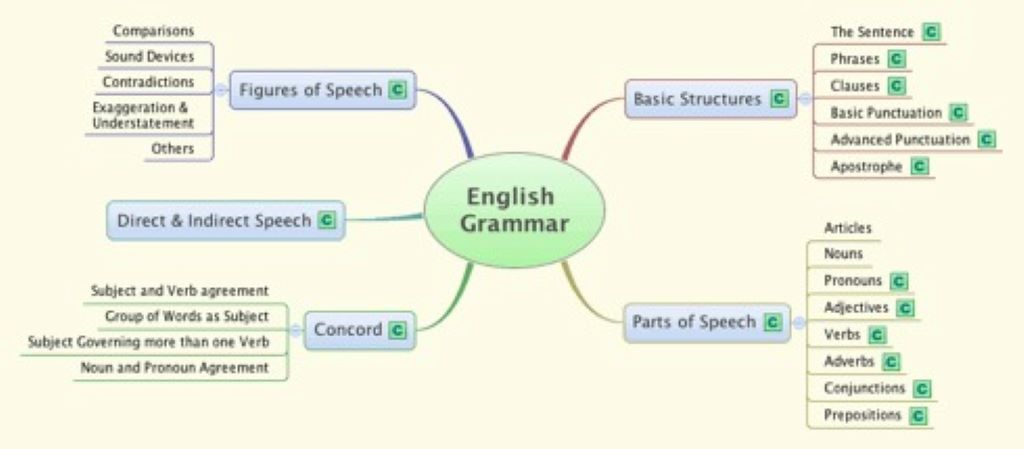
Mind mapping can be tailored to any grammatical concept. Here are a few examples:
Tackling Verb Tenses
Imagine struggling with 12 English verb tenses. A mind map organizes them into past, present, and future categories. From there, sub-branches highlight simple, continuous, perfect, and perfect continuous tenses, with examples like:
- Present Continuous: I am studying grammar.
- Past Perfect: She had completed her mind map before the exam.
This breakdown transforms an intimidating list into an easily digestible visual guide.
Mastering Subordinate Clauses
Subordinate clauses often confuse learners with their dependency on main clauses. A mind map could feature:
- Adverbial Clauses (When, While, Because)
- Relative Clauses (Who, Which, That)
- Noun Clauses (What, That, Whether)
Add examples and usage rules to each branch for clarity.
Tools and Platforms for Digital Mind Mapping
While pen and paper work well for mind mapping, digital tools offer added benefits like flexibility and collaboration. Some top-rated platforms include:
- MindMeister: Ideal for creating collaborative maps with an intuitive interface.
- XMind: Offers templates tailored for educational use, including grammar studies.
- Coggle: Simple and effective for visualizing connections.
For those comparing language-learning tools, consider Duolingo vs Babbel. You can find insights by clicking on https://dldxedu.com/e-learning/babbel-vs-duolingo-choosing-the-right-language-learning-app/.
Integrating Mind Mapping into Your Study Routine
To maximize the benefits of mind mapping, integrate it into your daily practice:
- Start Small: Dedicate 10 minutes daily to updating or reviewing a map.
- Combine with Practice: Use your map as a reference while solving exercises.
- Teach Others: Explaining your map to peers reinforces your understanding.
FAQs
What are the benefits of using mind maps for grammar?
Mind maps simplify complex rules, boost retention, and enhance creativity. They also foster a deeper understanding by visually connecting concepts.
Can I use mind maps for language learning apps like Duolingo or Babbel?
Absolutely! Mind maps complement apps like Duolingo and Babbel by organizing grammar rules learned during lessons.
Which tools are best for digital mind mapping?
MindMeister, XMind, and Coggle are excellent platforms for creating detailed and visually appealing mind maps.
How often should I review my mind maps?
Review your maps weekly to reinforce learning and update them as you learn new concepts.
Are mind maps effective for beginners in grammar?
Yes, mind maps are particularly helpful for beginners as they simplify and organize information visually.
What is the best way to create a grammar-focused mind map?
Start with a central topic, break it into branches, add examples, and use color-coding for clarity.
You Might Enjoy: Using a Humidifier to Alleviate Dry Scalp in Winter Months
Conclusion
Mastering complex grammatical structures is no longer an uphill battle with the strategic use of mind mapping. By organizing rules, examples, and exceptions into a visually engaging format, you unlock a powerful tool that transforms the way you learn and retain grammar. Whether you’re delving into verb conjugations, subordinate clauses, or comparative structures, mind maps offer clarity and confidence.