

10 Mar How to Select the Right Golf Simulator Mats for a Home Setup
Building a home golf simulator represents a significant investment in your game. While many enthusiasts focus heavily on projectors, software, and launch monitors, the foundation of your setup literally lies beneath your feet. Choosing the right mat can mean the difference between improving your swing and developing bad habits or even sustaining injuries.
The surface you hit from affects everything about your practice experience. It influences the feedback you receive, the accuracy of your swing data, and your long-term joint health. A quality simulator hitting mat provides realistic turf interaction while protecting your clubs and body from the repetitive impact of indoor practice.
This comprehensive guide will walk you through everything you need to know about selecting the perfect indoor golf mat for your home setup. You’ll discover what separates premium options from budget alternatives, how to match mat features to your skill level, and which factors truly matter for creating an effective practice environment.
Understanding Mat Construction and Materials
The construction of your practice surface determines how it performs and how long it lasts. Different materials and manufacturing approaches create vastly different hitting experiences, even among mats that look similar at first glance.
Traditional synthetic turf mats use nylon or polypropylene fibers attached to a rubber backing. These basic designs are affordable but can be unforgiving on your joints and clubs. The fibers often wear down quickly, and the hard base provides minimal shock absorption.
Multi-layer construction represents a significant upgrade. These mats combine different materials to create zones that mimic real fairway conditions. The top layer provides realistic grass interaction, middle layers absorb shock, and the bottom layer ensures stability. This engineering approach delivers better performance and durability.
Gel-infused materials have emerged as a premium option. These advanced designs incorporate gel layers that cushion impact while maintaining enough firmness for accurate ball striking. The gel helps distribute force across a larger area, reducing stress on your wrists, elbows, and shoulders.
Fiber density and length also affect performance significantly. Shorter, tighter fibers resist wear better but may feel less realistic. Longer fibers provide more natural turf interaction but can mat down over time. Quality manufacturers carefully balance these factors to optimize both realism and longevity.
Additionally, some advanced mats feature replaceable hitting surfaces. This modular approach lets you swap out the top layer when it wears while keeping the base intact. This design extends the overall life of your investment and maintains consistent performance.
Evaluating Shock Absorption and Joint Protection
Hitting hundreds of balls during indoor practice sessions creates repetitive stress that natural turf helps absorb. Your mat must provide adequate cushioning to prevent injuries and allow for extended practice without discomfort.
The human body wasn’t designed for hitting golf balls off hard surfaces repeatedly. Each impact sends force up through your hands, wrists, elbows, shoulders, and back. Poor shock absorption leads to fatigue, pain, and potentially serious injuries that can sideline your golf game entirely.
Premium mats incorporate multiple layers specifically engineered for impact absorption. These layers work together to dissipate force similar to how natural turf and the soil beneath it respond to club strikes. This cushioning protects your joints without creating an artificially soft surface that would provide unrealistic feedback.
Testing shock absorption requires actually hitting balls off the mat. Pay attention to how your hands and arms feel after twenty or thirty swings. Quality mats should feel comfortable throughout your session, while inadequate options will leave your joints aching.
Furthermore, consider your practice volume when evaluating shock absorption needs. Golfers who plan to practice daily require more protection than those using their simulator occasionally. Your age and any existing joint issues should also factor into this decision.
Look for mats that specify their shock absorption properties. Manufacturers of quality products typically provide details about their cushioning technology and the testing behind it. Vague descriptions or complete silence on this topic often indicate minimal investment in joint protection.
Size Considerations for Your Space
Selecting the appropriate size requires balancing available space, budget, and the realistic hitting area you need. Bigger isn’t always better, but insufficient size creates frustration and limits your practice effectiveness.
Measure your available space carefully before shopping. Consider ceiling height, which affects your swing plane and club selection during practice. Most golfers need at least nine feet of ceiling clearance for comfortable driver swings. Additionally, account for the width and depth needed for your stance and follow-through.
Standard mat sizes range from small stance mats around two feet by three feet up to massive fairway-style options spanning five feet by ten feet or more. The right size depends on your swing characteristics, practice goals, and available room.
Stance-only mats save space and money but require precise ball placement. You must position the ball at the edge of the mat for proper contact, which feels unnatural and limits shot variety. These compact options work for putting practice or chipping but fall short for full swing work.
Larger mats allow you to vary ball position naturally and practice different lies. You can work the ball back in your stance for punch shots or forward for sweeping drives. This versatility makes practice more realistic and valuable. However, these bigger options demand more floor space and cost significantly more.
Consider whether you’ll practice full swings only or incorporate short game work. If you plan to practice chipping and pitching, a longer mat lets you position yourself at various distances from the ball. This capability adds tremendous practice value without requiring separate equipment.
Think about future needs as well. Your simulator might start as a driver practice tool but evolve into a full game improvement system. Buying a larger mat initially saves the expense and hassle of upgrading later as your practice routine expands.
Texture and Realistic Ball Interaction
The surface texture of your mat directly affects how your club interacts with it and how the ball responds. This interaction influences both the realism of your practice and the accuracy of data from your launch monitor.
Real grass provides varying resistance depending on how you strike it. A descending blow compresses the grass differently than a sweeping motion. Quality mats attempt to replicate this variable resistance through their fiber design and density.
Some mats feature directional fibers that respond differently based on your swing path. These advanced designs help you feel whether you’re coming too steep or too shallow, providing valuable feedback that improves your swing. However, they require proper orientation and regular rotation to prevent uneven wear patterns.
Ball spin rates change based on the surface condition. Worn mats with matted-down fibers reduce spin compared to fresh surfaces. This inconsistency makes it difficult to trust your launch monitor data and can lead to incorrect club fitting decisions or swing adjustments based on false information.
Moreover, consider how different clubs interact with the surface. Your wedges should be able to grip the mat for realistic spin generation. Your irons should provide feedback about whether you’re taking proper divots. Your woods should allow for the slight sweeping motion required for optimal contact.
Testing different textures helps identify what feels most natural for your swing. Visit golf shops or simulator facilities that let you hit various mat types. Notice which surfaces provide feedback that matches your on-course experience most closely.
Portability and Storage Options
Not everyone has dedicated space for a permanent simulator setup. Many golfers need mats they can deploy for practice and then store away. Understanding portability features helps you choose options that fit your lifestyle.
Weight affects how easily you can move your mat. Light mats are easier to relocate but may slide during use. Heavier options stay planted but become difficult to manage, especially for those practicing alone. Look for mats in the fifteen to thirty-pound range for a good balance.
Foldable designs offer convenience but often compromise on quality. The fold lines become weak points that wear faster and create inconsistent hitting surfaces. If you need a foldable mat, choose one with reinforced fold areas and accept that you may need to replace it more frequently.
Roll-up mats provide another portable solution. These thinner designs work well for practice but typically lack the multi-layer construction that provides superior shock absorption. They suit golfers who prioritize convenience over premium performance.
Storage requirements vary dramatically between mat types. Flat mats need substantial floor space when stored. Foldable versions reduce storage footprint significantly. Consider where you’ll keep your mat between practice sessions and whether you have appropriate space.
Additionally, think about setup time. Some mats simply unroll and flatten quickly. Others require assembly or need time to relax into proper shape after storage. If you’ll be setting up and breaking down frequently, convenience features become increasingly important.
Compatibility with Launch Monitors and Technology
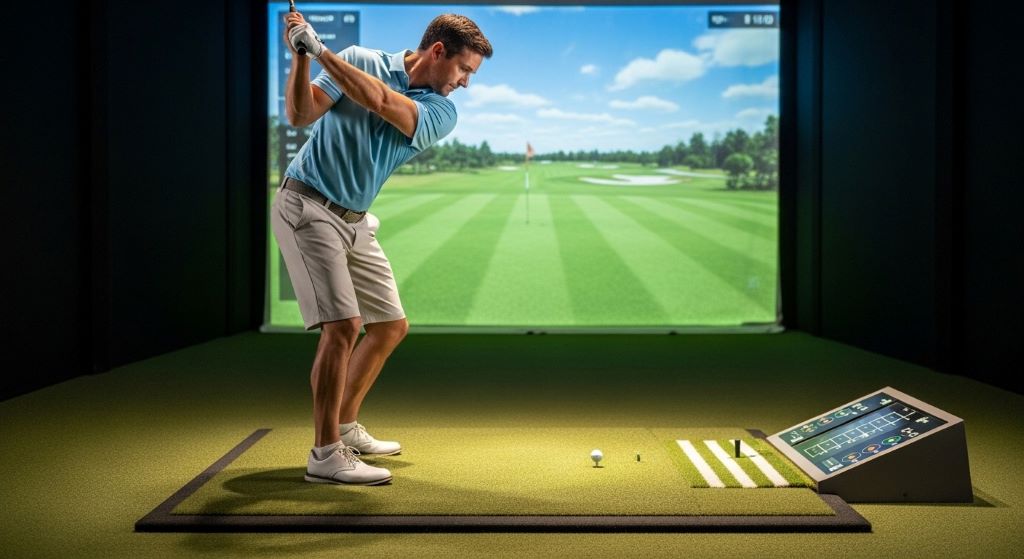
Modern golf simulators rely on launch monitors to track ball and club data. Your mat choice can affect the accuracy of these measurements and your ability to position sensors correctly.
Some launch monitors sit behind you and track the club and ball through radar technology. These systems generally work with any mat since they don’t require specific markings or alignment features. However, the mat surface still affects ball flight through spin rate changes.
Camera-based systems often need clear views of the ball and club at impact. Highly textured mats or those with patterns can interfere with tracking. Check your launch monitor manufacturer’s recommendations for compatible mat surfaces before making a purchase.
Alignment markings on mats help you set up consistently. Quality mats include subtle lines or markings for ball position and stance alignment. These features ensure you’re practicing with proper setup and make it easier to position yourself correctly relative to your simulator screen.
Furthermore, some advanced mats incorporate sensors that provide additional swing data. These smart surfaces track weight transfer, club path, and other metrics beyond what traditional launch monitors measure. While expensive, they offer practice insights that can accelerate improvement.
Consider cable management as well. Launch monitors, lighting, and other equipment require power and data connections. Mats that accommodate cable routing help keep your setup organized and reduce tripping hazards during practice sessions.
Durability and Longevity Factors
Your mat represents a significant investment that should last for years. Understanding what affects durability helps you choose options that maintain performance over thousands of swings.
Fiber quality determines how well the surface resists wear. Cheap fibers mat down quickly, creating bare spots and inconsistent ball interaction. Premium synthetic turf uses harder-wearing materials specifically engineered for repetitive club strikes.
The backing material must withstand constant impact without breaking down. Rubber compounds vary in quality, with cheaper options cracking or separating from the turf layer. High-density rubber or foam backings maintain integrity much longer.
Stitching and seam strength matter more than most buyers realize. Poorly constructed mats develop edge fraying and seam separation. Quality manufacturing includes reinforced edges and strong stitching that keeps layers bonded together through extended use.
Usage patterns affect longevity significantly. Hitting from the same spot repeatedly wears that area faster. Rotating your mat periodically distributes wear more evenly. Some golfers mark multiple hitting zones to extend overall mat life.
Additionally, maintenance practices influence how long your mat lasts. Regular brushing keeps fibers upright. Cleaning removes dirt and debris that accelerate wear. Simple care routines can double or triple the usable life of quality mats.
Warranty coverage provides insight into manufacturer confidence. Companies offering multi-year warranties typically use better materials and construction. Read warranty terms carefully to understand what’s covered and any usage limitations.
Price Ranges and Value Assessment
Golf mats span an enormous price range, from basic options under one hundred dollars to premium systems costing over a thousand. Understanding what you get at different price points helps maximize value.
Budget mats provide basic functionality for casual practice. They offer a hitting surface that’s better than concrete or carpet but lack the sophisticated construction of premium options. Expect limited shock absorption, faster wear, and less realistic ball interaction.
Mid-range options deliver significantly better performance without breaking the bank. These mats typically feature multi-layer construction, decent shock absorption, and materials that last several years with regular use. This category offers the best value for most home simulator builders.
Premium mats incorporate advanced materials, superior engineering, and features like replaceable surfaces or integrated sensors. They’re designed for daily practice and provide the most realistic experience possible indoors. The higher cost reflects better materials, more extensive development, and longer warranties.
Consider cost per practice session rather than just upfront price. A premium mat lasting ten years with daily use costs pennies per session. A cheap mat needing replacement annually becomes more expensive long-term despite the lower initial investment.
However, match your investment to your commitment level. Beginners uncertain about their long-term simulator use might start with mid-range options. Serious golfers dedicated to regular practice should invest in premium surfaces from the beginning.
Don’t forget about hidden costs. Some mats require additional underlays or foam pads for proper performance. Factor these accessories into your total budget when comparing options.
Additional Features and Accessories
Beyond basic construction, various features and accessories enhance your practice experience and protect your investment. Understanding these options helps you create a complete, functional setup.
Underlays or shock pads provide extra cushioning beyond what the mat itself offers. These separate layers sit beneath your mat and further reduce impact forces. They’re particularly valuable for golfers with joint concerns or those practicing on concrete floors.
Tee holders built into the mat eliminate the need for separate rubber tees. Quality integrated tee systems adjust for different heights and angles. They provide consistent ball positioning and withstand thousands of swings without loosening.
Edge beveling prevents tripping and makes the mat easier to walk across. Beveled edges also reduce the likelihood of damage from vacuum cleaners or foot traffic. This simple feature significantly improves safety and usability.
Moisture resistance matters if you’ll be using your simulator in basements or other areas prone to humidity. Some materials resist mold and mildew better than others. This consideration becomes important for long-term mat health and hygiene.
Furthermore, consider whether you need chipping surfaces or rough areas. Some mats include multiple turf textures that simulate different lies. These practice zones add variety without requiring separate equipment.
Carrying cases or storage bags protect your mat during transport or storage. If you’ll be taking your mat to different locations or storing it in dusty areas, proper protection extends its life and maintains cleanliness.
Making Your Final Decision
After understanding all the factors, the selection process becomes more straightforward. A systematic approach ensures you choose a mat that truly fits your needs and budget.
Start by defining your non-negotiable requirements. List features you absolutely must have, such as minimum size, specific shock absorption levels, or portability needs. This clarity prevents being swayed by sales pitches or attractive but irrelevant features.
Research manufacturers with strong reputations in the golf simulator community. Read reviews from actual users who have logged significant practice time on their mats. Pay particular attention to long-term performance reports rather than initial impressions.
If possible, test before buying. Many golf retailers have simulator setups where you can hit different mat types. Spend time on each option, hitting enough balls to notice differences in feel, feedback, and comfort.
Compare warranty and return policies carefully. Reputable manufacturers stand behind their products with solid warranties. Favorable return policies let you test the mat in your actual setup without risking your money if it doesn’t meet expectations.
Create a spreadsheet comparing your top choices across key criteria like size, shock absorption, durability features, price, and warranty. This visual comparison often reveals the best option for your specific situation.
Remember that your mat is the foundation of your entire simulator experience. Choosing wisely now prevents frustration, potential injury, and the expense of replacing inadequate equipment later. Take time to make an informed decision that supports your golf improvement goals.
Conclusion
Selecting the right golf simulator mats for your home setup requires careful consideration of multiple factors. The ideal simulator hitting mat combines proper size for your space, adequate shock absorption for joint protection, realistic turf interaction for accurate practice, and construction quality that ensures years of reliable use.
Understanding mat materials, construction methods, and design features helps you evaluate options effectively. Consider how different aspects like portability, technology compatibility, and additional features align with your specific needs. Match your investment level to your practice commitment and improvement goals.
Quality indoor golf mat options exist at various price points, making it possible to find suitable solutions for nearly any budget. However, remember that your mat directly affects practice quality, injury risk, and the accuracy of your simulator data. Investing in appropriate quality pays dividends through better practice experiences and longer equipment life.
Take time to research thoroughly, test when possible, and choose based on your actual requirements rather than marketing claims or price alone. The right mat becomes an invisible foundation that supports consistent, productive practice. Your future self will thank you for making a thoughtful decision that enhances every simulator session for years to come.
Frequently Asked Questions
What thickness should I look for in a quality golf simulator mat?
Quality mats typically range from one to two inches thick, though thickness alone doesn’t guarantee performance. Multi-layer construction matters more than total thickness. Look for mats with at least three distinct layers: a realistic hitting surface, shock-absorbing middle layer, and stable base. The combination of appropriate materials in proper layers provides better performance than a thick mat made from single-layer foam or rubber.
Can I use the same mat for both driver practice and short game work?
Yes, but you need adequate size and appropriate surface texture. A mat at least four feet by five feet allows positioning variety for different clubs. Look for models with turf that provides enough resistance for wedge shots while accommodating the sweeping motion of driver swings. Some premium mats include multiple surface zones specifically designed for different club types and shot varieties.
How do I prevent my mat from sliding during practice?
Several solutions help secure your mat. Rubber backing naturally grips most floor surfaces reasonably well. For extra security, use carpet tape, rubber underlays, or specialized mat grippers. On slick surfaces like tile, consider placing a large rubber pad beneath the entire mat. Some golfers build low-profile wooden frames around their mats to prevent movement completely.
What maintenance does a golf mat require to maximize its lifespan?
Regular brushing keeps fibers upright and prevents matting. Vacuum or sweep the surface weekly to remove dirt and debris. Clean spills immediately to prevent staining. Rotate the mat periodically to distribute wear evenly across different areas. For outdoor use or basement installations, ensure the mat dries completely after moisture exposure to prevent mold. Following these simple practices can double your mat’s usable life.
Are expensive premium mats really worth the extra cost for home use?
Premium mats justify their cost for golfers practicing regularly or those with joint concerns. They provide superior shock absorption, more realistic feedback, and last significantly longer than budget options. If you’ll use your simulator multiple times weekly, premium mats cost less per session over their lifetime than repeatedly replacing cheaper alternatives. However, occasional users might find mid-range options provide adequate performance at better initial value.
Related Topics:
How Hitters Adjust to Big League Cutter Movement
How to Choose an Affordable Electric Surfboard Without Sacrificing Quality